A child in the womb does not breathe through its nose or mouth, and it lives. For Chinese longevity practitioners that was not a biological curiosity but a program. If the embryo is sustained without breathing, then an adult who could return to the embryo's way of breathing could return to the embryo's vitality — and perhaps to its freedom from death. The practice is called taixi (胎息), "embryonic breathing", and its history is one of the clearest examples of a technique changing its meaning completely while keeping its name.
Eating breath
The idea that breath could replace food is very old. The Mawangdui tomb sealed in 168 BCE held a manual called Quegu shiqi, "Abstaining from grain and eating qi", which tells the practitioner to give up cereals and live on breath and certain plants. "Those who eat grain eat what is square," it says; "those who eat qi eat what is round." By the second and first centuries BCE, the historian Robert Campany concludes, the combination of grain avoidance and breath-eating was commonplace among people pursuing long life.
Holding the breath
The first detailed account of embryonic breathing is Ge Hong's, around 317 CE. "Of the several methods of circulating breath," he writes, "the essential one is simply embryonic breathing. One who attains it can breathe without using the nose or mouth, as though in the womb." His method is retention. Draw the breath in through the nose and hold it, counting heartbeats; let it out through the mouth so faintly that a feather held there does not stir; start at about a hundred and twenty, and work toward a thousand.
Later manuals were just as literal. Sun Simiao, the great Tang physician, describes holding the breath for three hundred counts, until hearing and sight fail. Joseph Needham and Lu Gwei-djen, looking at these accounts, read the resulting sensations — dizziness, ringing, lights, a kind of euphoria — as the effects of oxygen deprivation. Whatever else it was, early embryonic breathing was a hard physical discipline with real risks.
The turn inward
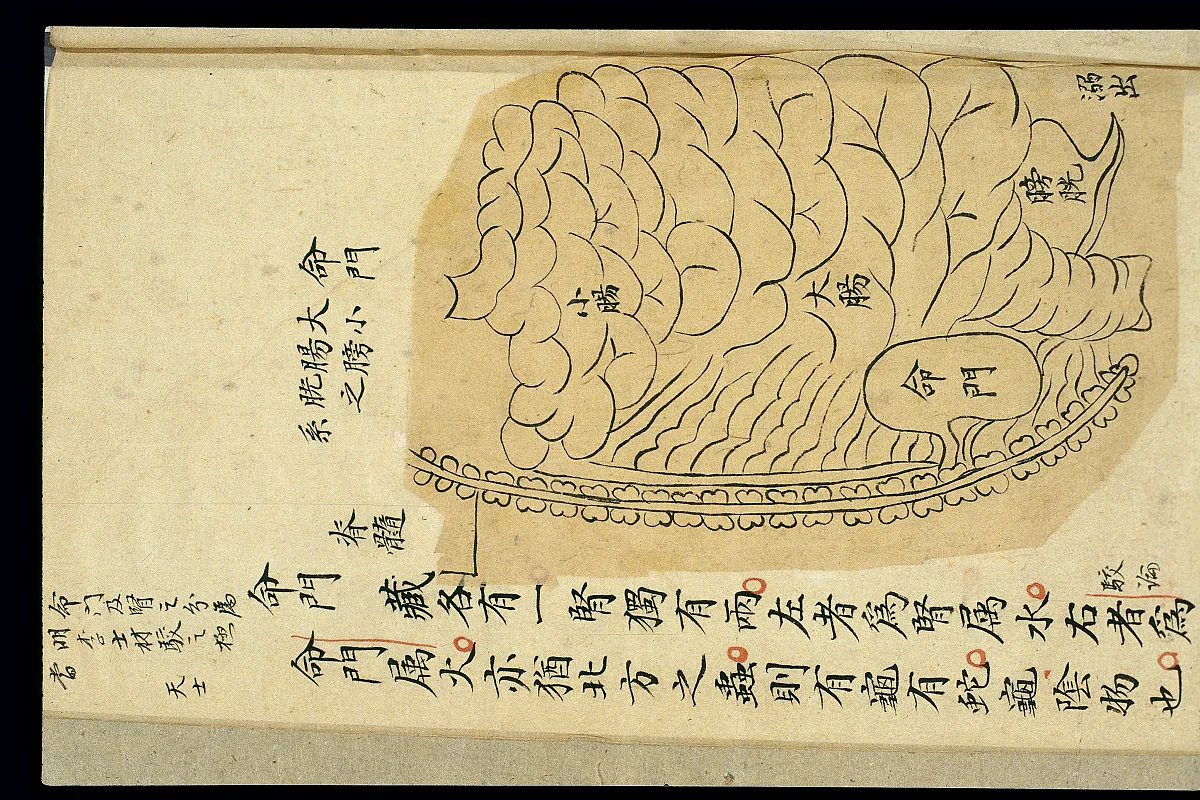
Then the meaning changed. The French sinologist Henri Maspero, in a long study published in 1937, traced the shift to the middle of the Tang. Taoist writers of the eighth century began to argue that working with outside air was nothing special — physicians taught it too — and that the old texts had really meant something else. The breath that mattered was not the external breath, waiqi, but the internal one: the original breath, yuanqi, stored in the body since conception, centred below the navel and between the kidneys at the gate of life. That breath was not to be taken in from outside but kept, gathered and circulated — and it must never be mixed with ordinary air.
The short Tang text known as the Scripture of Embryonic Breathing, eighty-eight characters long and probably from the middle of the eighth century, states the new view in its first line: "The embryo forms within the hidden breath; the breath comes to rest within the embryo." Retention becomes stillness. Counting becomes attention. The goal is no longer to stop breathing for as long as possible, but to let the outer breath grow so quiet that the inner one can be felt moving on its own.
Maspero did not live to see his work widely read in English: he was arrested by the Gestapo and died in Buchenwald in March 1945. The essay was translated into English in 1981, in the collection Taoism and Chinese Religion, and it remains the starting point for the subject.
Where it ended up
That inner version passed directly into internal alchemy, where embryonic breathing is the quiet, almost imperceptible breathing of a practitioner whose attention rests in the lower field — the condition in which the "embryo" of the later stages is said to be conceived. In modern teaching, Yang Jwing-Ming's book on the subject treats it as the work of filling the lower dan tien, which is the closest published description of what Mo Pai's first level asks for.