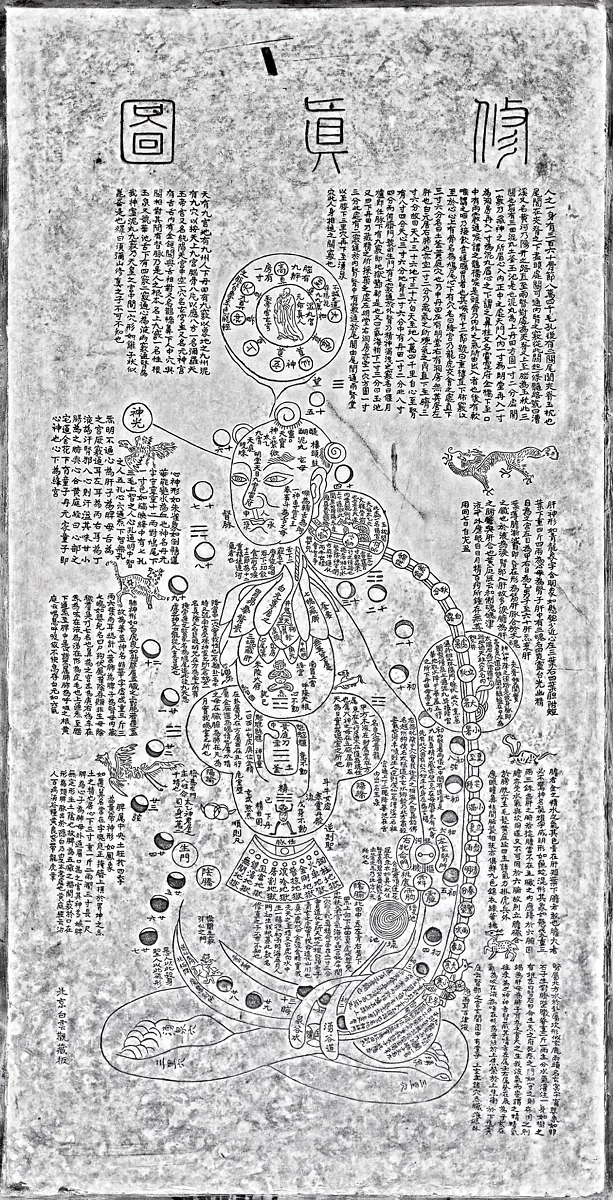
If you want to know where a Mo Pai instruction comes from, you do not look in the Mozi. You look in the neidan corpus, where it is discussed at greater length, with more care, and a thousand years earlier than any Mo Pai document.
Neidan (內丹) means "the internal elixir", and the name is a deliberate transposition. For centuries Chinese alchemists had pursued immortality through waidan, external alchemy: cinnabar, lead, mercury, and sealed crucibles, which produced a real chemical literature and killed a documented number of emperors. Neidan takes the entire apparatus — furnace, cauldron, ingredients, firing schedule, the elixir itself — and relocates it inside the practitioner's body. The body is the crucible; the ingredients are its own substances; the fire is the breath and the attention.
The ladder
The framework almost every neidan text shares is a three-stage refinement, each stage transforming one substance into a finer one. Lian jing hua qi — refining essence into qi — is the foundation, worked in the lower field, and classically allotted a hundred days. Lian qi hua shen refines qi into spirit, in the middle field, over a longer period. Lian shen huan xu refines spirit and returns it to emptiness. Along the way the tradition describes gathering the two poles and fusing them, driving the result up the spine through three gates and around a circuit, and gestating an immortal embryo that eventually leaves the body as a yang shen.
Every one of those terms is standard. The three fields, the three spinal gates, the perineal seal, the small and great circulations, the kan-li fusion of water and fire, the embryo, the yin and yang spirit bodies, immortality as the terminus: this is the vocabulary of internal alchemy as it developed from roughly the Tang dynasty onward, and none of it is original to Mo Pai.
The literature
| Text or corpus | Date | What it contributes |
|---|---|---|
| Cantong qi (參同契) | Han, expanded later | The founding text of Chinese alchemy, read as both external and internal; the cosmological scaffolding of trigrams and firing times. |
| The Zhong-Lü corpus | Tang–Song | Attributed to Zhongli Quan and Lü Dongbin: the first systematic step-by-step internal method, and the direct ancestor of everything after it. |
| Wuzhen pian (悟真篇) | 1075 | Zhang Boduan's verse classic, the central text of the Southern lineage and the standard reference for kan-li work. |
| Longmen commentaries | Ming–Qing | The monastic elaboration: staged curricula, timing, and the practical warnings that come with them. |
Where Mo Pai sits in it
Precisely, and lower than most people assume. Everything Mo Pai has published — levels 1 to 4, the filling of the lower field, the drive through the gates, the fusion of yin and yang, and the projection of the result — is an unusually forceful and unusually literal version of the first of those three refinements. The middle-field work, the embryo, the spirit bodies and the return to emptiness are all above the point where the published record stops. Seventy-two rungs, and the documented part covers the first of three transitions.
What is distinctive is not the map but the reading of it. Neidan is written in dense symbolic language, and most lineages treat the imagery as instructions for a subtle process. Mo Pai reads it as engineering: the charge is literal, the polarity is literal, the electricity is measurable, and the demonstrations are physical. That literalism is the tradition's actual signature, and it is why the comparison with other systems is more interesting than the family resemblance suggests.