Mo Pai is routinely described as Taoist, including in the subtitle of the book that made it known — The Magus of Java: Teachings of an Authentic Taoist Immortal. The word is doing a lot of work there and it is worth unpacking, because Taoism is not one thing, and Mo Pai fits some parts of it exactly and others not at all.
Two words that get translated the same way
Chinese distinguishes daojia (道家), the "Tao school" — the philosophical tradition of the Daodejing and the Zhuangzi — from daojiao (道教), the "Tao teaching" — the organised religion with priests, liturgy, deities, scripture, ordination, and temples. English collapses both into "Taoism", which is why Western readers so often picture a philosophy of effortless flowing and are startled to discover a two-thousand-year-old religion with a canon of fifteen hundred texts and a functioning priesthood.
The sharp division between the two is itself partly an invention — a Han-dynasty bibliographic convenience, hardened by later Western scholarship that wanted the poetry without the ritual. Modern scholars generally treat them as one continuous tradition with a philosophical stratum and a religious one that constantly borrow from each other. For present purposes the distinction is still useful, because Mo Pai belongs to neither in the ordinary way.
The philosophical stratum
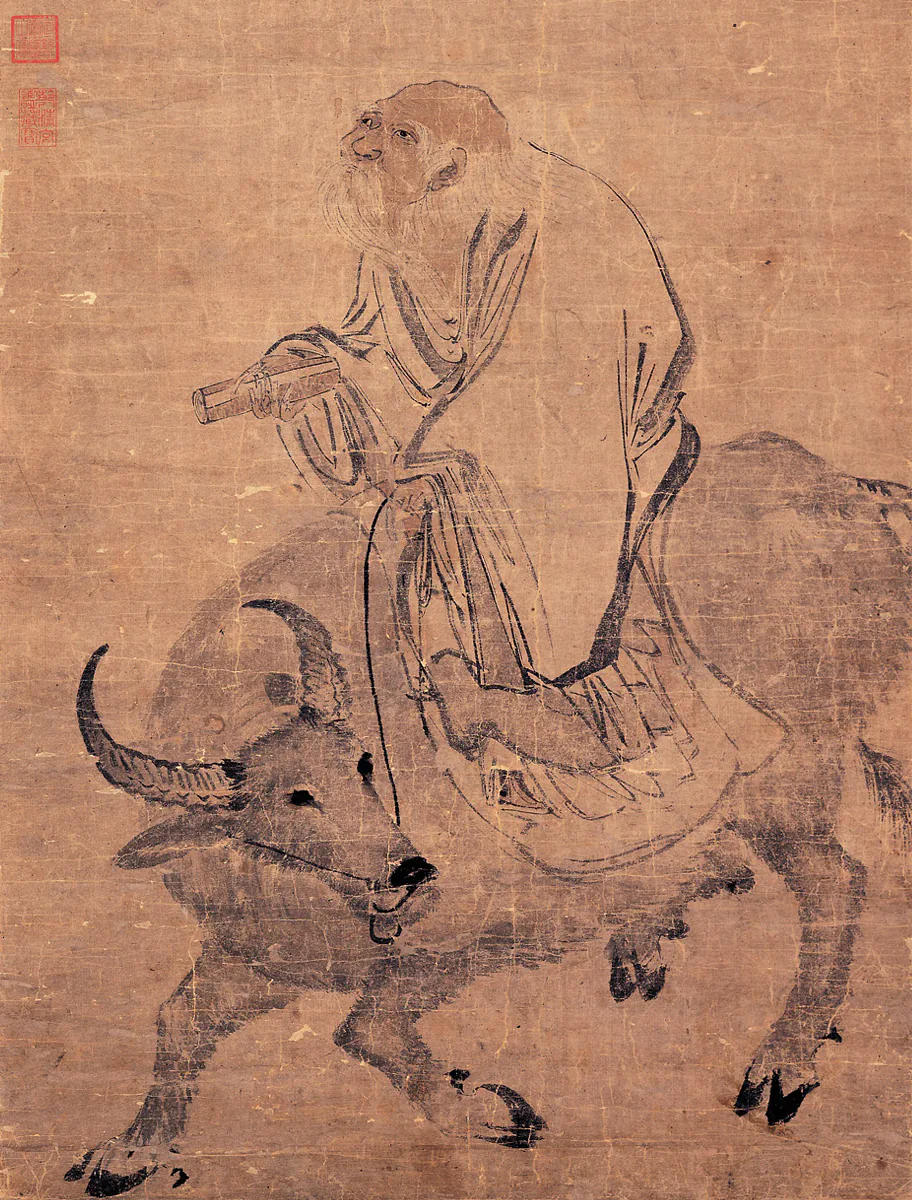
The Daodejing (道德經), traditionally attributed to Laozi and in its received form assembled by around the third century BCE — with substantially older material, as the Guodian bamboo manuscripts of c. 300 BCE confirm — sets out the vocabulary: the Tao as the unnameable source and course of things; de (德) as its expression in a particular thing; wu wei (無為) as action that does not force; ziran (自然) as things being spontaneously so; the value of the soft, the low, the empty, the uncarved.
The Zhuangzi (莊子), whose inner chapters date to roughly the fourth century BCE, is stranger and funnier: a deep distrust of language and categories, a delight in the useless, and the figure of the zhen ren (真人), the "true person" who "breathes with their heels" while ordinary people breathe with their throats. That line is the first appearance in Chinese literature of the idea that a realised person breathes differently, and it echoes through everything that follows — including, twenty-three centuries later, the Mo Pai instruction to make the breath long and low.
The religious stratum
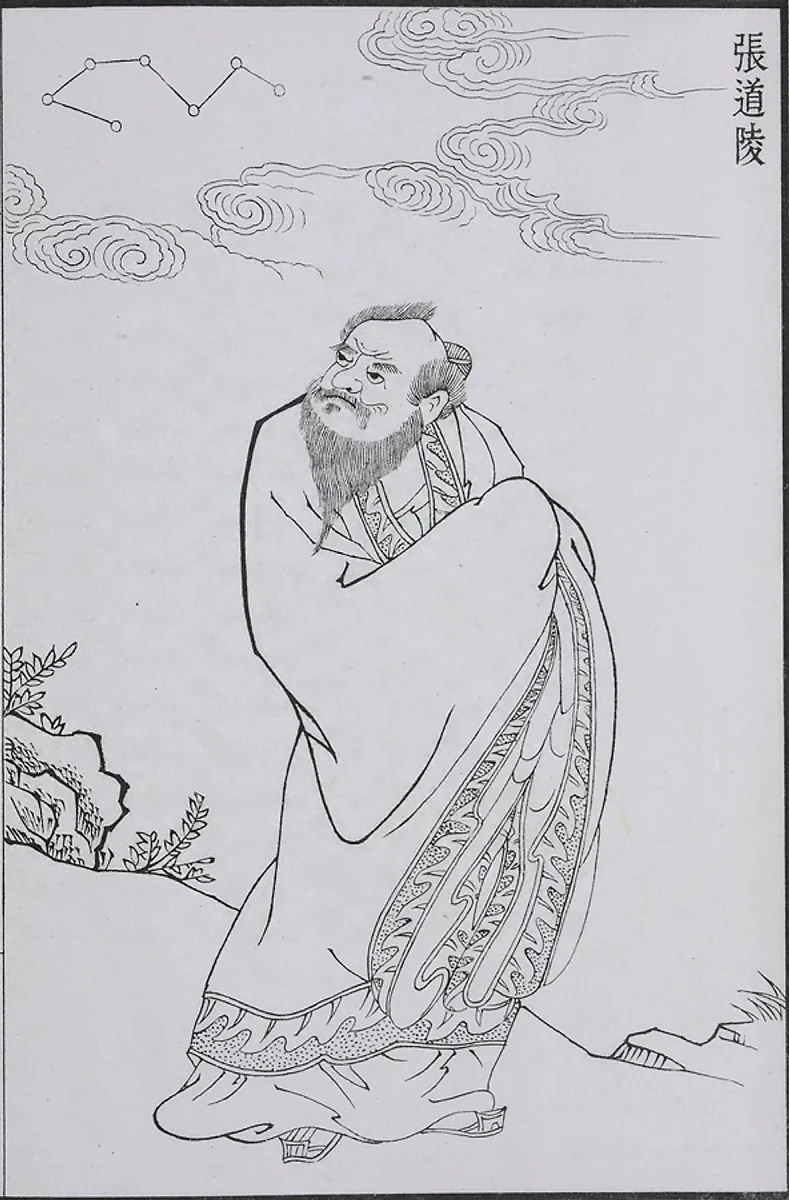
In 142 CE Zhang Daoling reported a revelation from the deified Laozi and founded the Way of the Celestial Masters — a functioning theocratic community with registered households, a priesthood, and rites of confession and healing. This is where Taoism as an organised religion begins, and every later ordination lineage traces itself to it.
What follows is a long history of revelation and consolidation. The Shangqing (Highest Clarity) revelations of 364–370 CE brought an interior, visionary practice of meditation and celestial ascent. The Lingbao (Numinous Treasure) corpus around 400 CE brought communal liturgy and Buddhist-influenced cosmology. The Daozang, the Taoist canon, accumulated across centuries into the Ming edition of 1445 with roughly fifteen hundred titles. Two orders dominate the present: Quanzhen (全真, "Complete Perfection"), founded by Wang Chongyang in the twelfth century and monastic, celibate, and internal-alchemical in emphasis; and Zhengyi (正一, "Orthodox Unity"), descended from the Celestial Masters, whose priests marry, live in the community, and specialise in ritual. The Longmen (龍門, "Dragon Gate") branch of Quanzhen, traced to Wang's student Qiu Chuji, is the one whose name turns up most often in discussions of neigong.
The alchemical project
Running through both strata is a project with no close Western equivalent: the deliberate transformation of a human being into a xian (仙) — an immortal or transcendent. Not a soul surviving death, but a person who does not undergo it in the ordinary way, or who departs by shi jie (尸解), "liberation by means of a corpse", leaving behind a body that turns out to be a sword or a staff or a set of clothes.
The first method was waidan (外丹), external alchemy: elixirs compounded from cinnabar, mercury, lead and arsenic, prepared in a laboratory. It ran for centuries and it killed people, including several Tang emperors. Its failure is one of the forces that produced the successor.
Neidan (內丹), internal alchemy, from roughly the Tang onward, moved the laboratory inside. The body became the crucible; the ingredients became the body's own jing, qi, and shen; the furnace became the lower dan tien; and the entire technical language of the external art was retained as metaphor and instruction at once. The Zhong-Lü corpus, Zhang Boduan's Wuzhen pian of 1075, and the Longmen commentaries lay out the sequence that Mo Pai's levels 1 to 4 restate almost exactly: refine essence into qi, qi into spirit, spirit into emptiness; complete the small and great circulations; fuse water and fire; gestate the immortal embryo; deliver the yang shen.
Two further neidan concepts are worth carrying into any reading of Mo Pai. Xing ming shuang xiu (性命雙修), "dual cultivation of nature and life", is the tradition's insistence that psychological-spiritual work (xing) and physiological work (ming) must proceed together; the northern and southern schools disagreed mainly about which to begin with. And the body is understood as a landscape and a cosmos — an inner country with passes, gates, palaces, rivers and resident deities — which is why the spinal gates have names like "jade pillow" rather than vertebral numbers.
Where Mo Pai actually sits
Against that background, Mo Pai is easy to place technically and very hard to place institutionally.
By method, it is straightforwardly neidan. Dan tien accumulation, the microcosmic and macrocosmic orbits, the three spinal gates, the perineal seal, the kan-li fusion of water and fire, the jing-qi-shen ladder, the immortal embryo, the yin and yang spirit bodies, hsien-hood as the terminus: every single term is standard internal alchemy, and none of it is original. If you want the theory behind a Mo Pai instruction, you look it up in the neidan literature, where it is discussed at far greater length and with a thousand years more care. See Mo Pai in Context.
By institution, it is nothing at all. No ordination lineage. No liturgy, no scripture, no canon, no deities, no temple, no monastery, no priesthood, no ritual calendar, no talismans, no transmission register. Nobody in the story is a Taoist priest. A Quanzhen monk and a Zhengyi ritual master would both recognise the vocabulary immediately and would both find the absence of everything else remarkable.
By claimed genealogy, it is Mohist — which is the genuinely odd part. Mohism was a rival school to the Taoists and the Confucians, mocked by name in the Zhuangzi, committed to impartial care, frugality, opposition to fatalism, and the technical defence of cities. It was a disciplined organisation of logicians and military engineers, and it produced the most rigorous surviving Warring States work on optics, mechanics and argument. Nothing in the Mohist canon describes internal cultivation. Nothing in the Taoist canon describes a Mohist internal art. Mo Pai therefore claims descent from a school with no cultivation literature while practising a method drawn wholesale from a different tradition, and the sources offer no account of when or how the transfer happened. See The Lineage: Mo Tzu to Java.
There is a real category that fits it better than any of the above: the lay and martial internal traditions, transmitted in families, in martial lineages, and through individual teacher-to-student relationships entirely outside temple structures. These are numerous, historically real, and badly documented almost by definition — they have no institutions to leave records. A Chinese internal art carried by immigrants to Java, kept within a community that had excellent reasons for keeping things quiet, taught to a handful of people without ceremony, would sit naturally in that category. It would also, by the same token, be unverifiable, which is precisely the situation.
| Stream | Period | What it consists of | Mo Pai's relation to it |
|---|---|---|---|
| Daojia (philosophical) | c. 4th–3rd c. BCE | Daodejing, Zhuangzi; wu wei, ziran, the zhen ren | Shares the goal-vocabulary; cites none of the texts |
| Celestial Masters / Zhengyi | 142 CE onward | Priesthood, ritual, community liturgy | No connection |
| Shangqing / Lingbao | 4th–5th c. CE | Visionary meditation, celestial ascent, scripture | No connection |
| Waidan | Han–Tang | Laboratory elixirs of cinnabar and mercury | No connection |
| Neidan | Tang onward | The body as crucible; orbits, kan-li, the embryo, the yang shen | The direct technical parent |
| Quanzhen / Longmen | 12th c. onward | Monastic, celibate, internal-alchemical | Same methods, full institutional apparatus |
| Lay and martial nei kung | Throughout | Family and teacher-to-student transmission, no institution | Where Mo Pai plausibly belongs |
| Mohism | c. 5th–3rd c. BCE | Ethics, logic, optics, siege engineering | The claimed ancestor; no cultivation content |
The Javanese context
One further placement is often skipped. Chinese religion in Indonesia developed its own forms, notably the syncretic Tridharma or Sam Kauw current that treats Confucianism, Buddhism and Taoism as one body of practice, and it operated for three decades under a state that suppressed Chinese language, names and public cultural expression. Whatever Liao Sifu carried to Java was carried into that environment, not into a temple system. It is a context that would tend to strip a transmission down to its transmissible core — a teacher, a student, and a method — and to leave no paper behind. That is consistent with what Mo Pai looks like. It is equally consistent with there being nothing to document.