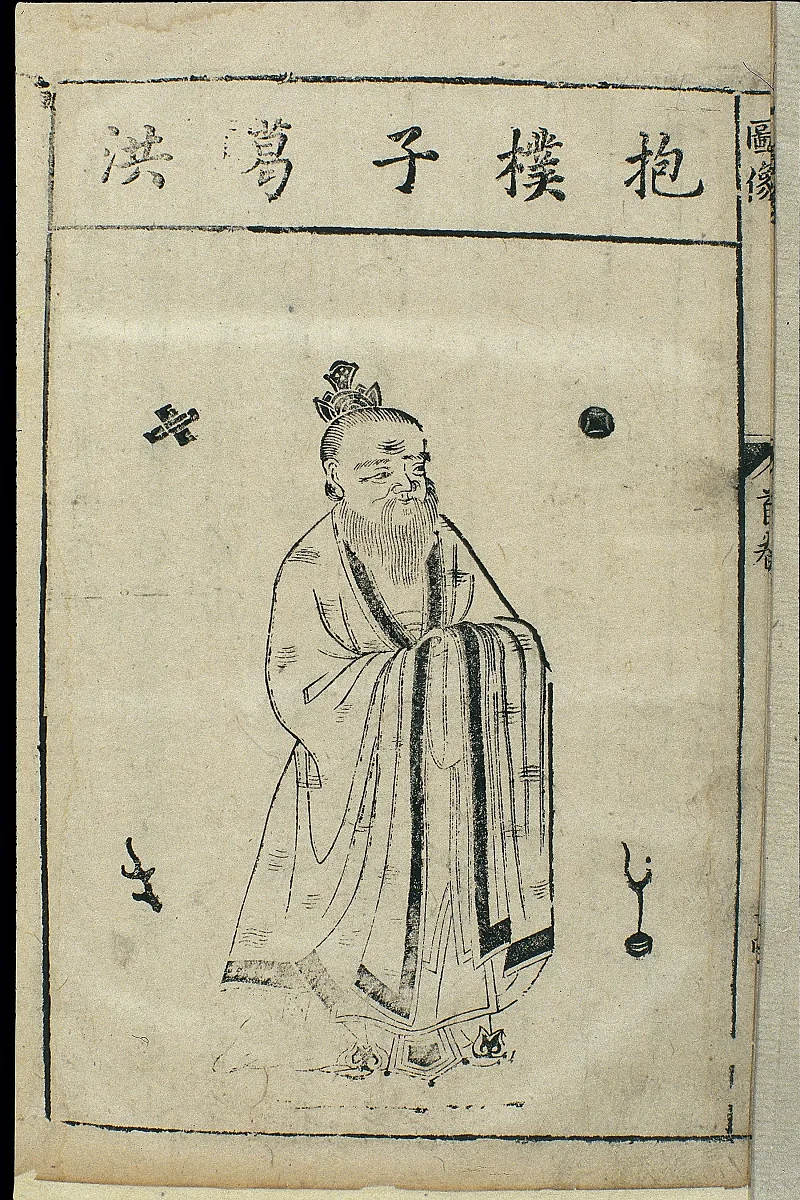
If you want to know what the early Chinese alchemists were actually doing — not what their scriptures said in code, but what a practitioner bought, where he went, whom he trusted and what he thought of everyone else — there is essentially one place to look. It is the Baopuzi (抱朴子), "The Master Who Embraces Simplicity", by Ge Hong, and it is the fullest account of the subject written before the tenth century.
The man
Ge Hong was born in 283 into a southern family of officials, near modern Nanjing, in the decades after the fall of the Han. The standard date for his death is 343; some sources, following the dynastic history's statement that he died at eighty-one, put it twenty years later. He served in the army, received a minor title for suppressing a rebellion, held office, wrote a great deal, and spent his last years on Mount Luofu in the far south, reportedly still working on elixirs.
He was not a priest and not a hermit. He was a scholar from the class that ran the state, and he wrote two books under one name to prove it. The fifty Outer Chapters are about government, ethics and literature, and in them he writes as a Confucian. The twenty Inner Chapters, completed around 317 and revised around 330, are about becoming a transcendent. He saw no contradiction between the two, and that is itself a fact about the period worth holding on to.
The teachers
Ge Hong says the alchemical scriptures came to him by a chain of four. A master named Zuo Ci received them; Zuo Ci gave them to Ge Hong's great-uncle, Ge Xuan; Ge Xuan gave them to his disciple Zheng Yin; and Zheng Yin, after the boy had served him for about five years from the age of fourteen, gave them to Ge Hong. The texts he names are the Scripture of Great Clarity, the Scripture of the Nine Tripods and the Scripture of the Golden Liquor — the core of what is now called the Great Clarity tradition, the earliest identifiable school of Chinese alchemy.
Two things about that chain are worth noticing. One is that Ge Hong is our only real source for most of it. The other is the emphasis he places on it: again and again the Inner Chapters insist that a written recipe is useless without oral instruction from a teacher who has it from a teacher. That is the earliest clear statement in Chinese of the principle every later lineage, Mo Pai included, depends on.
The ranking
The Inner Chapters describe nearly every longevity practice of the period: herbal and mineral drugs, sexual techniques, talismans, grain avoidance, gymnastics, meditation on the gods of the body, and the circulation of breath. Ge Hong practised several of them and does not dismiss any. But he ranks them, and the ranking is blunt. "Without the golden elixir," he writes, "those who take only herbal drugs and practise minor arts can extend their years and postpone death, but cannot become transcendent."
The elixir — jindan, the golden elixir, and above all the reverted elixir, cinnabar cycled through its transformations — is the only thing that works. Everything else is maintenance. People who think breathing alone will do it are, in his phrase, repeating "a biased discourse of the schools of the circulation of breath".
What he says about breathing
He still takes breathing seriously, and he is the earliest writer to describe the practice that later becomes central to the internal tradition. "Of the several methods of circulating breath," he writes, "the essential one is simply embryonic breathing. One who attains it can breathe without using the nose or mouth, as though in the womb." The method he gives is retention: draw the breath in, hold it while counting heartbeats, release it so faintly that a feather held at the nostrils does not move, and extend the count over time toward a thousand.
Read alongside his ranking, that passage is easy to misjudge. For Ge Hong, embryonic breathing is a valuable minor art — it heals, it lets you stay underwater, it supports the real work. It is not the real work. The idea that the breath and the body could themselves be the furnace, and that no elixir needed swallowing at all, is four or five centuries away.
The other book
Ge Hong is also credited with the Shenxian zhuan (神仙傳), "Traditions of Divine Transcendents" — a collection of biographies of people who had achieved the goal. The original is lost; the versions that survive are later compilations, and how much of them is Ge Hong's is debated. Robert Ford Campany's reconstruction from early citations is the closest a modern reader can get. It is where Wei Boyang's dog-and-elixir story comes from, and it is the template for every later collection of immortals' lives — including, in a sense, the stories told about John Chang.