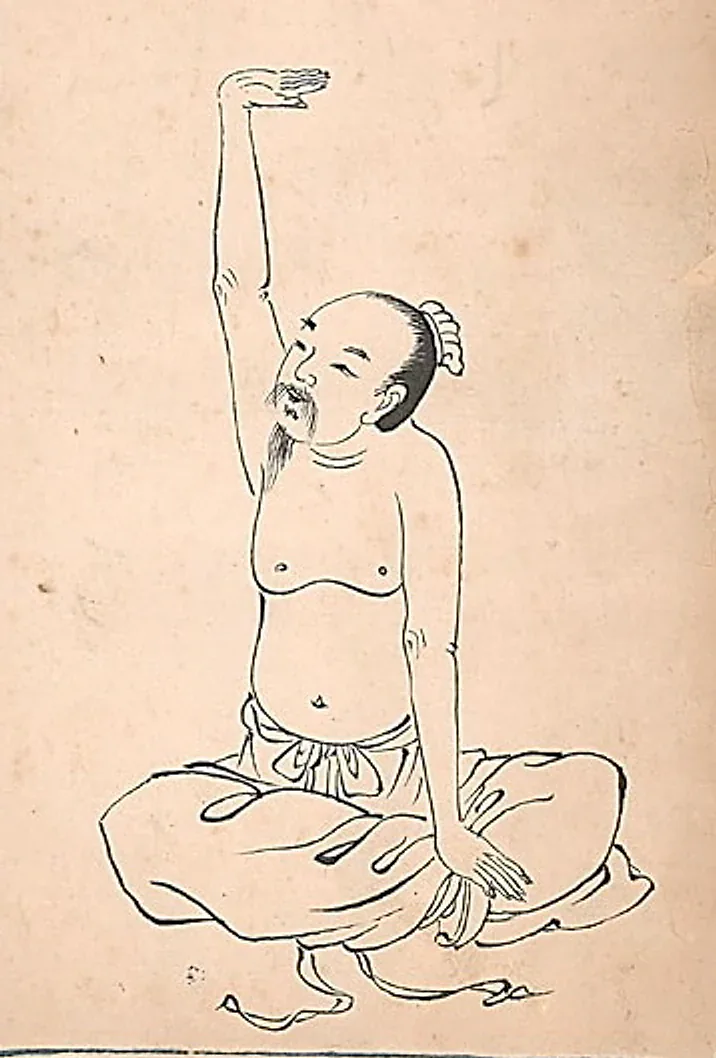
If someone in a park in China, or a hospital rehabilitation ward, or a community hall in Europe is doing qigong, the odds are good that it is this. The baduanjin (八段錦), the "eight pieces of brocade", is a short sequence of eight movements — reaching up, drawing a bow, raising one arm and pressing down the other, turning the head to look behind — each with its own name and its own claimed benefit. It takes about fifteen minutes. The name compares the set to a fine silk woven in eight panels.
The first mention
The name first appears in the twelfth century, in the Yijian zhi, a vast collection of strange tales by the Song scholar Hong Mai. In 1117, he writes, a court official named Li Siju "would get up at midnight, sit, and do breathing and self-massage — what is called the eight brocades". The words "what is called" matter: the name was already current. China's own Health Qigong authority cites this passage as the earliest record of the set.
Notice what the official was doing: sitting, at midnight, breathing and massaging. The earliest baduanjin was a seated practice. Within a few decades the Taoist encyclopedist Zeng Zao described it — scholars disagree about whether his version is the seated or the standing one — and by about 1300 the Xiuzhen shishu, a large Taoist compilation, attributed the set to Zhongli Quan and Lü Dongbin. The standing form most people learn today was fixed much later, in the Qing; a popular story credits it to the general Yue Fei, which historians treat as legend.
The family tree
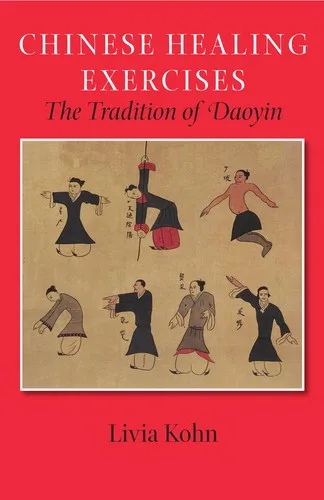
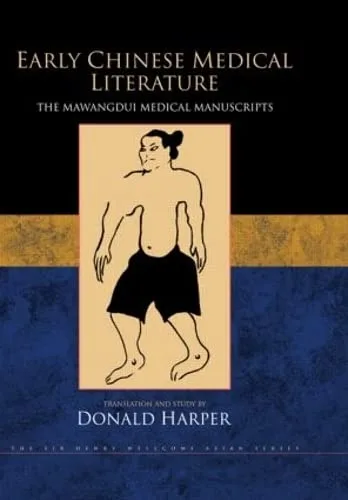
The baduanjin is a late member of a very old family. In 1983–84 archaeologists opening tomb 247 at Zhangjiashan, in Hubei, found a bamboo-slip manual called the Yinshu (引書), the "Pulling Book", buried around 186 BCE. It is the oldest surviving treatise on daoyin: seasonal routines, named exercises — many named after animals — and specific movements for specific complaints. It presents itself as "the way of Ancestor Peng", and it explains, with some sympathy, that ordinary people fall ill because of toil, hunger, and never having learned these methods.
Eighteen years later the Mawangdui chart was sealed into a tomb at Changsha, and many of its painted figures are doing exercises the Yinshu describes in words. Four centuries after that, the historian Chen Shou records the physician Hua Tuo teaching his disciple Wu Pu a set called the "Frolics of the Five Animals" — tiger, deer, bear, ape and bird — to keep the body moving "as a door-hinge does not rot". Wu Pu, the account says, practised it into his nineties with his hearing, sight and teeth intact. The original movements are lost; every modern five-animal set is a reconstruction.
| Date | Source | What it shows |
|---|---|---|
| c. 186 BCE | Yinshu, Zhangjiashan | Named exercises in prose; health as a matter of daily method |
| 168 BCE | Daoyin tu, Mawangdui | The same family of movements, painted |
| late 3rd c. | Hua Tuo in the Sanguozhi | An animal set taught by a named physician |
| 1117 | Hong Mai, Yijian zhi | The name "eight brocades", already familiar |
| 2003 | China’s sport administration | A standardised "Health Qigong" form |
The modern standard
In 2003 the Health Qigong Management Center of China's General Administration of Sport issued a standardised baduanjin, alongside new versions of the five animals and two other traditional sets, and promoted it nationally through what became the Chinese Health Qigong Association. It is that 2003 form — deliberately stripped of religious content, presented as exercise — that most clinical trials use and that most people now learn. In a sense it is the endpoint of the process described on How "qigong" was invented: an ancient practice preserved by being turned into physiotherapy.
Does it work?
For some things, probably, a little — but the evidence is weaker than its volume suggests. A 2017 meta-analysis of nineteen randomised trials, most published in Chinese, found improvements in quality of life, sleep, balance, grip strength, flexibility, blood pressure and resting heart rate. A 2020 review of more than eight hundred baduanjin studies found that almost all came from mainland China, that very few clearly concealed allocation or blinded their assessors, and that adverse events were rarely even reported. A 2022 appraisal of the systematic reviews on baduanjin for diabetes rated every one of them "critically low" in quality.
The honest summary is the one the reviews give: many small, unblinded trials consistently report modest benefits for things gentle regular exercise is known to help, and the certainty of the evidence is low to very low. None of it bears on the claims made for internal power. It is good evidence that moving slowly every morning is good for you.