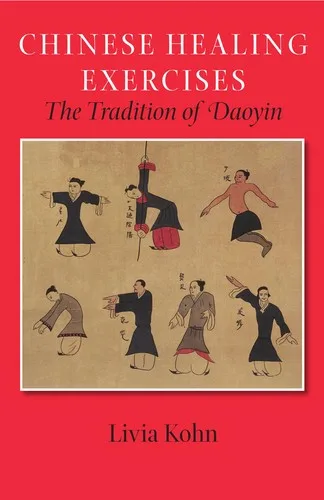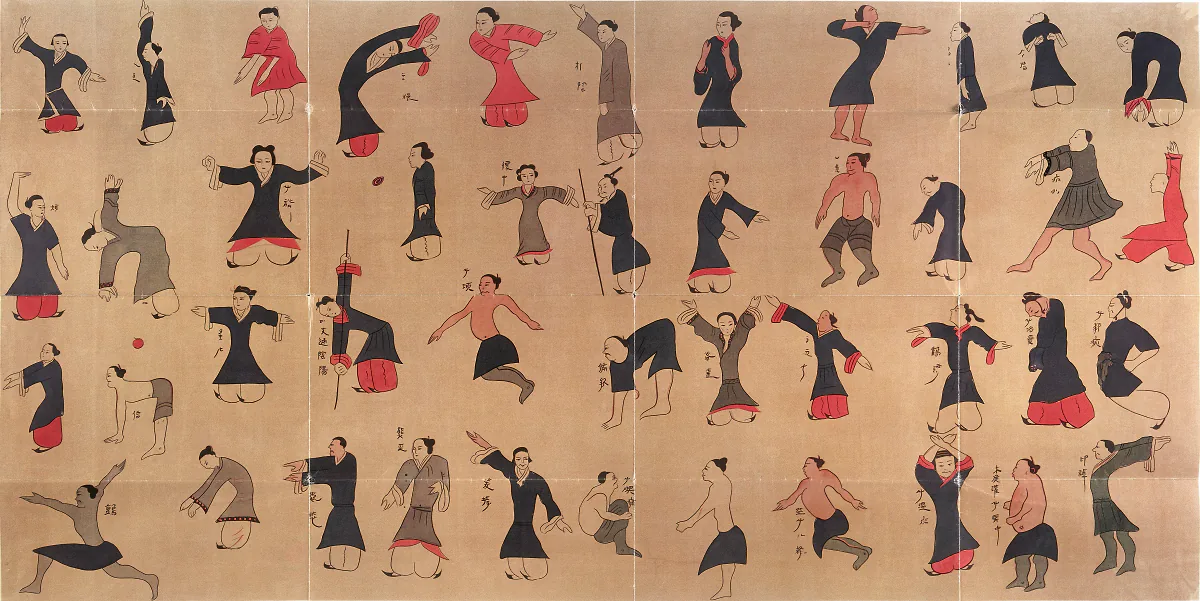
In 1973 and 1974, excavation of three Han tombs at Mawangdui near Changsha produced one of the great manuscript finds in Chinese history: silk copies of the Daodejing older than any previously known, medical and divinatory texts, maps, and — from tomb 3, sealed in 168 BCE — a painted silk chart of forty-four human figures, each in a different posture. It is called the Daoyin tu (導引圖), the chart of guiding and pulling.
What is on it
The figures are ordinary people rather than deities or immortals: men and women, clothed and partly unclothed, old and young, standing, bending, stretching, twisting, and in some cases holding an object. Short captions survive beside some of them. A few name an ailment the movement is for — complaints of the knee, deafness, accumulations in the abdomen. Others name an animal whose movement is being imitated: the bear, the bird, the ape. The chart is a therapeutic exercise programme, and it treats imitation of animals as a technique rather than a metaphor.
Daoyin is the classical name for this: "guiding and pulling", meaning guiding the qi and stretching the body. It appears in the Zhuangzi, disapprovingly, as the speciality of people who want to live a long time and do nothing else. The Mawangdui chart is what those people were actually doing, in colour, three centuries before anybody wrote a manual that survives.
Why it matters for this subject
Modern qigong descends from daoyin far more directly than from anything alchemical. The baduanjin, the yijinjing, the five-animal frolics attributed to Hua Tuo, the sets taught in Chinese hospitals in the 1950s and in parks in the 1980s: they are all in the family this chart belongs to. When somebody says qigong is two thousand years old, this is the object that makes the claim defensible.
It also draws the line that this archive keeps having to draw. Daoyin is movement therapy — external, physical, prescribed for named conditions. What the Neiye describes, and what Mo Pai does, is something else: sitting still, doing nothing visible, and working on the inside. The two traditions run alongside each other for two thousand years, borrow from each other constantly, and are not the same practice. Mo Pai is emphatically not in this picture: there are no forms, no sets, and no movements at all in its method until level 2.