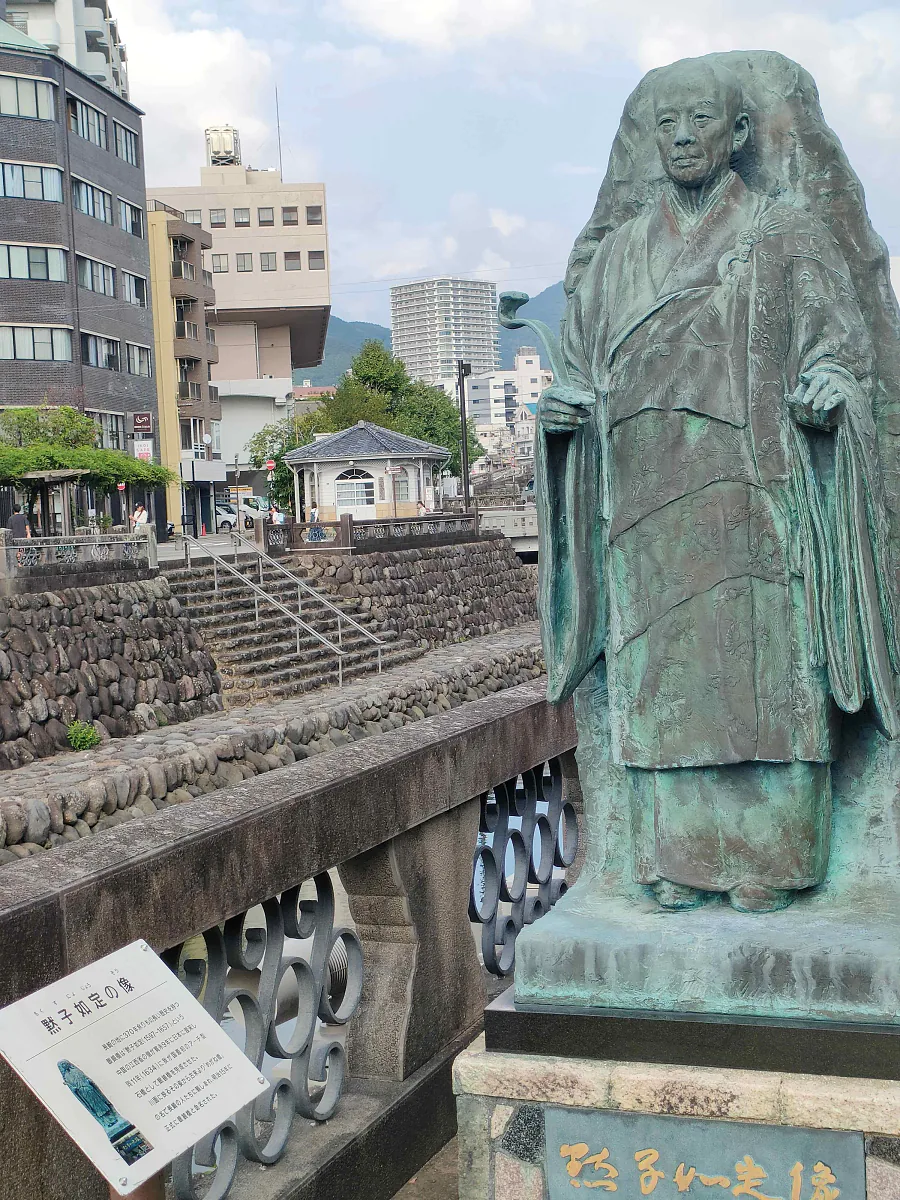
Mo Pai means "the school of Mo", and the Mo it means is Mo Di — Mozi, who lived roughly 470 to 391 BCE and founded the only organised philosophical movement of the Warring States period that could also build you a working crossbow emplacement. The claim of descent is the tradition's foundation, and the school it names is real, well documented, and unusually interesting in its own right.
The world they appeared in
The Zhou kings had ruled, in theory, since the eleventh century BCE. By Mo Di’s lifetime the theory was all that was left. The realm had come apart into states that fought each other continuously, and the period takes its name from the fact: the Warring States. Armies grew from a few thousand aristocratic charioteers to conscript infantry numbering in the hundreds of thousands. Siege warfare became the decisive form, which meant that the fate of a city could turn on whether anyone present understood counter-mining, signal fires and the defence of a gate.
Into that came the hundred schools — itinerant teachers selling rulers a theory of order. Confucius had died around 479 BCE leaving a programme built on ritual, family feeling and the cultivation of the gentleman. The Mohists were the first sustained answer to it, and they answered as engineers answer: by asking what a doctrine costs, who it benefits, and whether it works.
Mo Di
The dates usually given are about 470 to 391 BCE, both uncertain. So is nearly everything else. He may have come from Song or from Lu; the sources disagree, and the disagreement is old. Even the name is contested. Mo (墨) means ink, and the readings offered for it run from a surname, to the tattooing inflicted on convicts, to the sunburn of men who worked outdoors — the last two both making "Mo Di" a nickname for a man of the labouring classes rather than a gentleman’s name.
What the text shows is consistent with that. The Mozi is preoccupied with craft, measurement, cost and use. Its author knows how walls are built and how carts are made, argues in the vocabulary of the workshop, and treats the standards of the carpenter — the compass, the square, the plumb line — as the model for standards in ethics. He is reported to have trained in Confucian learning first and broken with it, which would explain how precisely his objections land: he attacks funerals, music and fatalism, which are the three places where Confucian practice was most expensive and least defensible on grounds of use.
An organisation, not a reading group
This is what separates the Mohists from every other school of the period. They were a disciplined order under an appointed head, the juzi (鉅子), who could assign members to posts in the service of a state and require them to remit their salaries to the school. Members took the doctrine as binding on their own lives: they wore rough clothes, ate plainly, and worked. Later writers found them admirable and impossible in roughly equal measure. The Zhuangzi, no friend to them, called their way too hard for most people to bear, and noted that they were willing to bear it.
The best-attested demonstration of what that discipline meant is grim. Meng Sheng, a juzi of the late fourth century, had undertaken to hold the city of Yangcheng for a lord who had died. The claim on the city was disputed, the position was hopeless, and a follower argued that dying for it would serve nobody and would end the school. Meng Sheng answered that if the Mohists broke faith once, nobody would ever trust a Mohist with anything again. He sent two men to carry the succession to Tian Xiangzi in Song, then died with a hundred and eighty-three of his followers. The two messengers delivered the succession and went back to Yangcheng to die as well, against the explicit order of their new head.
After Mo Di’s death the movement split into three branches, each holding that it had the orthodox canon. The division is usually given as the Xiangli, Xiangfu and Dengling groups, and the surviving text preserves the fracture: several of the core doctrines appear in three parallel versions, which is why the Mozi contains chapters that say nearly the same thing three times in slightly different words.
What they actually did
Two things, mainly, and both are unusual for a philosophical school.
The first was to intervene in wars. The most famous episode has Mo Di hearing that the state of Chu is preparing to attack Song using scaling ladders built by the master craftsman Gongshu Ban. He walks for ten days and ten nights to reach the Chu court. There he first argues the case — taking a rich man who steals his neighbour’s chicken as the analogy — and then, when argument does not settle it, proposes a demonstration: he and Gongshu Ban will simulate the siege on a table, with belts for walls and sticks for engines. Gongshu Ban attacks nine times and is repulsed nine times. Out of moves, Gongshu Ban observes that there is one way left to win, and Mo Di says he knows what it is: kill him. He then notes that three hundred of his disciples are already on the walls of Song, trained in his methods, and that killing him would not undo them. The attack is called off.
Whatever the historicity of the details, the practice behind the story is well documented in the text itself. Eleven chapters of the Mozi are a technical manual of city defence: walls and their heights, gates, moats, watchtowers, signals, stores, the handling of tunnels driven under the wall, incendiaries, the organisation of the population, the treatment of spies. It is written by people who had done it.
The second thing is stranger. Inside the received text sit six chapters — the Canons and their Explanations, together with the chapters on names and on disputation, collectively the Mojing — which are unlike anything else in early Chinese literature. They are terse, numbered propositions on optics, mechanics, geometry, economics and logic. They contain the earliest known description of the camera obscura, correctly explaining the inverted image by the straight-line travel of light through a small aperture. They treat concave and convex mirrors and where the image forms. They state the law of the lever in terms of weight and distance from the fulcrum. They define the point, the line, the circle and the parallel. They analyse how words refer, how a claim can be shown false, and what makes an argument valid.
The turning point is the place where the shadow is. Light reaching the person is like the shooting of arrows: what comes from below goes up, and what comes from above goes down.
The Mojing, on the inverted image in a pinhole
Nothing continued from it. There is no Chinese tradition of geometry proceeding from those definitions, no optics building on those propositions. The work is a dead end, not because it was wrong but because the people doing it stopped existing.
The ten doctrines
The core teaching is set out as ten theses, each with its own group of chapters. They are best read as a single argument rather than as a list: everything else follows from the first, and the last two are the machinery that holds the whole thing up.
| Thesis | Chinese | What it says |
|---|---|---|
| Impartial care | 兼愛 jian ai | Care for others as you care for your own. The disorder of the world comes from partiality — from caring for your family, state or person more than another’s — and the remedy is to weigh everyone equally. |
| Against offensive war | 非攻 fei gong | An invasion is theft and murder at scale. Stealing a pig is punished, taking a state is celebrated, and the difference is only in the number of victims. Defensive war is permitted, and the Mohists fought it. |
| Elevating the worthy | 尚賢 shang xian | Office should go to ability, from any class, with the farmer or artisan raised if he is capable. An attack on hereditary aristocracy that was radical for the fifth century BCE. |
| Conforming upward | 尚同 shang tong | A shared standard of right, ascending from village to state to Heaven, so that a society is not paralysed by every person holding a private view of what is right. |
| Frugality in use | 節用 jie yong | Spend nothing that does not add use. Clothing for warmth, houses for shelter, and no ornament beyond it. |
| Frugality in burial | 節葬 jie zang | Against the lavish funerals and three-year mournings the Confucians defended: they impoverish the living, empty the treasury and take working people out of the fields for years. |
| Heaven’s intent | 天志 tian zhi | Heaven wants the world benefited and hates it harmed, and Heaven is impartial. It is the objective standard against which rulers are measured — the plumb line, not a comfort. |
| Understanding ghosts | 明鬼 ming gui | Spirits exist, see what is done and reward and punish accordingly. Argued from testimony, and defended for its effect on conduct as much as for its truth. |
| Against music | 非樂 fei yue | Not that music is unpleasant, but that state musical establishments consume the labour and grain of people who need both. The most consequentialist argument in the canon and the least popular. |
| Against fatalism | 非命 fei ming | There is no fixed fate. The doctrine that outcomes are settled in advance is attacked as the excuse of bad rulers and idle men, and as self-fulfilling. |
Ghosts and spirits
The Mohists believed in ghosts, and said so at length. This is not a decorative survival in their system; it is one of the ten theses, argued for in its own chapters and defended against people who thought it nonsense. Their opponents included plenty who did not believe — the text takes on the position that spirits do not exist and answers it directly — and the Mohist reply is the same kind of reply they give to everything else: look at the evidence, and look at what follows from believing it.
The evidence they offer is testimony. If a great many people across many generations report having seen and heard something, and the reports are consistent, that is the same footing on which we accept anything else we did not witness. The chapters accumulate cases: a duke killed by a spirit before witnesses at a hunt, a minister struck down in court, ghosts appearing to demand redress for a wrong. It is a documentary argument, and by the standards of the fifth century BCE it is not a lazy one.
What follows is enforcement. Spirits see what is done in private and reward and punish accordingly, which means there is no dark room in which a person can do wrong unobserved. The Mohists were explicit that a world where people believe this is a better-ordered world than one where they do not, and they were unembarrassed about saying that the belief is useful as well as true. Later Chinese thought largely went the other way — the Confucian temperament was to keep the spirits at a respectful distance and change the subject — which makes the Mohist position the more forthright of the two and, for this archive, the more interesting: it is the same combination of hard-headed measurement and a populated spirit world that runs through the whole tradition this site documents.
Against music, and against festivals
The objection to music is the one that lost them the most friends, and it is worth stating precisely because it is almost always reported wrongly. The Mohists did not say music was unpleasant. The text concedes at the outset that the great bells and drums and strings are delightful — that is not in dispute, and the argument would be pointless if it were. The objection is to what they cost.
A state musical establishment meant bronze bells cast in sets, hung on frames, and the workshops to make them. It meant dancers and performers taken off the land and fed. It meant the levies raised to pay for all of it, falling on people who were already short. Every hour a strong young man spends performing is an hour he is not farming; every hour a woman spends in the ensemble is cloth not woven. Set that against the three things the Mohists said a country actually needs — that the hungry are fed, the cold clothed, and the exhausted allowed to rest — and music does not deliver any of them. So it goes.
The same reasoning falls on every other expensive occasion, and this is where it bites hardest. Lavish funerals, the three-year mourning that took a man out of productive life, the great sacrificial feasts, the ceremonies by which rulers displayed themselves — all of it is wealth burned for display, and all of it is measured against what the same wealth would have done if it had been spent on people who needed it. The Mohist position is that a ruler who empties his treasury on ritual while his people go hungry has his priorities exactly inverted, and the tone in which they say it is not gentle. Nothing should be produced that does not add to use: clothing for warmth, houses for shelter, food for strength, and no ornament beyond it.
The best-known joke at their expense is Zhuangzi’s — that theirs was a doctrine to make people anxious and sad, that they sang no songs and mourned no dead, and that though the world could not bear it, they bore it themselves. It is a fair hit, and it is also a description of people who meant what they said.
What they took to be knowledge
Calling the Mohists scientists is an anachronism, but a smaller one than usual. They held that a claim has to be tested rather than inherited, and they built the apparatus for doing it: definitions that do not depend on the thing being defined, propositions stated so that they can be shown false, and observation as the arbiter. The pinhole chapter does not assert that light travels in straight lines; it accounts for an inverted image by that assumption, which is what an explanation is. The lever is stated as a relation between weight and distance rather than as a knack. The chapters on names and disputation ask what makes an argument valid — the only sustained formal logic produced in early China.
The three gauges below are the same instinct applied to doctrines rather than to mirrors, and the whole of it is of a piece: a school of engineers who thought ethics was the kind of thing you could get right or wrong, and that the way to tell was to look.
The ethics, and why it is unusual
Mohist ethics is consequentialist, and it is the earliest developed consequentialism anywhere. The test of a doctrine, a policy or an act is li (利) — benefit — understood concretely as the wealth of the people, the increase of the population and the ordering of the state. Not pleasure, not virtue, not the fulfilment of ritual: outcomes, measured in the things a hungry country needs.
The method is set out as three gauges. Where does a claim come from — is there precedent in the conduct of the sage kings? What is the evidence for it — what have the eyes and ears of ordinary people actually reported? And what happens if it is applied — does the state and the people benefit? A doctrine that fails the third gauge is rejected however venerable it is, and the Mohists apply this to funerals, music and fate without flinching.
The disagreement with the Confucians turns on the first thesis. Confucian ethics is graded: you owe more to your father than to a stranger, and the family is the school of every wider loyalty. The Mohists said this is where partiality enters and that partiality is the root of harm. Mencius understood the stakes and answered in kind, saying that to hold impartial care is to be without a father, and to be without a father or a ruler is to be an animal. It is worth noticing that the Mohists were not asking anyone to abandon their family — the argument is about the weight given to others in deciding what to do, and their answer to "will this work?" was pragmatic: a world of impartial carers is one in which your family is also cared for by everyone else.
Two supports hold this up, and both are argued rather than assumed. Heaven provides an external standard so that right does not reduce to whatever the ruler prefers. Spirits provide enforcement where no magistrate is watching. A modern reader tends to find the ghosts embarrassing and the optics impressive; the Mohists would not have recognised the distinction, because both are defended by the same appeal to testimony and use.
The disappearance
By the Han the organised movement is gone, and no source records how. The standard explanations are cumulative rather than singular: unification removed the small states whose survival made defensive specialists valuable; the Qin and then the Han built exactly the centralised order the Mohists had argued for, and had no use for an independent disciplined body inside it; the school’s demands were severe and its rewards worldly; and Confucianism became the state orthodoxy, after which the Mohist canon was a text nobody was examined on.
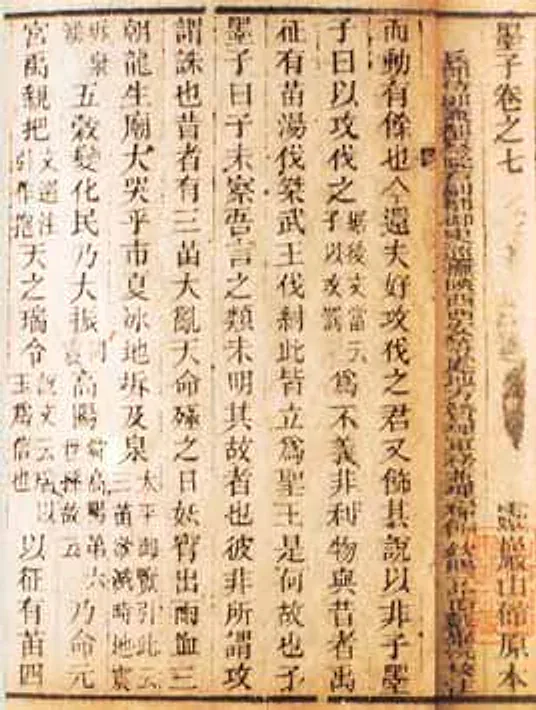
The book itself nearly went with them. Han bibliographies list seventy-one chapters; fifty-three survive. It came down largely inside the Taoist canon, preserved by people with no particular interest in what it said, and it was barely studied until Qing dynasty scholars returned to it — Bi Yuan in the eighteenth century, and then Sun Yirang, whose edition of 1894 made the technical chapters readable again after two thousand years. The optics were recognised for what they were only in the twentieth century.
What this has to do with Mo Pai
The honest summary is short. Everything above is a public philosophical and technical tradition: ten theses argued in the open, a manual of fortification, and a body of propositions about light and levers. There is no internal cultivation in it. No breathing method, no dan tien, no accumulation of qi, no ladder of levels, no immortality. The Mozi is a long book by a movement that wrote down what it thought, and what it thought was that resources should be spent on the people rather than on ritual, and that cities should not fall.
What the lineage claim takes from Mohism is the organisational shape rather than the content: a secretive, hierarchical, technically expert body under a single head, with a habit of keeping its methods to itself and a reputation for discipline. That shape is genuinely there, and it is the strongest part of the analogy.
Because the strongest evidence against the lineage claim is in the Mohist canon itself. The Mozi is a substantial body of writing by a movement that documented its own methods in operational detail — how to hold a gate, how to lay out a signal system, what a lever does, how an image inverts. It says nothing about breath, nothing about qi cultivation, nothing about the dan tien, nothing about seated practice, and nothing about internal power. The terms Mo Pai uses do not appear in it, and could not have: they belong to an alchemical vocabulary that developed more than a thousand years after Mozi died.