Almost every alchemical text written in China after the tenth century cites one book as its charter. It is short, it is in verse, it is extremely hard to read, and it has been called the king of the scriptures on the elixir — a title the Qing commentator Liu Yiming gave it in 1799, though the phrase is older than him. Its full name is Zhouyi cantong qi (周易參同契), and it is the reason the vocabulary Mo Pai uses is built out of trigrams, lunar phases and firing times rather than out of anatomy.
The title
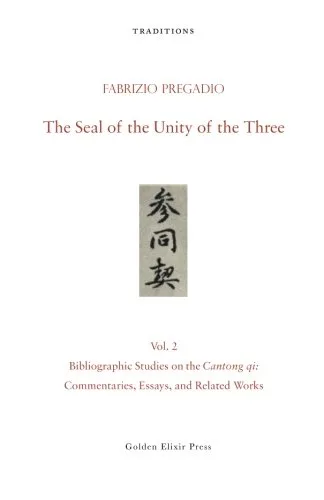
Zhouyi is the Book of Changes. Qi (契) is a tally — one half of a token split between two parties, which proves a match when the halves are put back together — and so a seal or a covenant. Cantong is the hard part. The character 參 can mean "to join" or can stand for 三, "three", and Fabrizio Pregadio, whose translation is the standard one in English, thinks both senses were intended: the text is about merging into unity, and about three things that do it.
The three are usually identified as the cosmology of the Book of Changes, the Taoist teaching of non-action, and alchemy itself. The book's claim is that these are not three subjects but one, seen from three sides — and a sixteenth-century rearrangement of the text, the so-called Ancient Text, divides it into three chapters on exactly those lines.
Who wrote it, and when
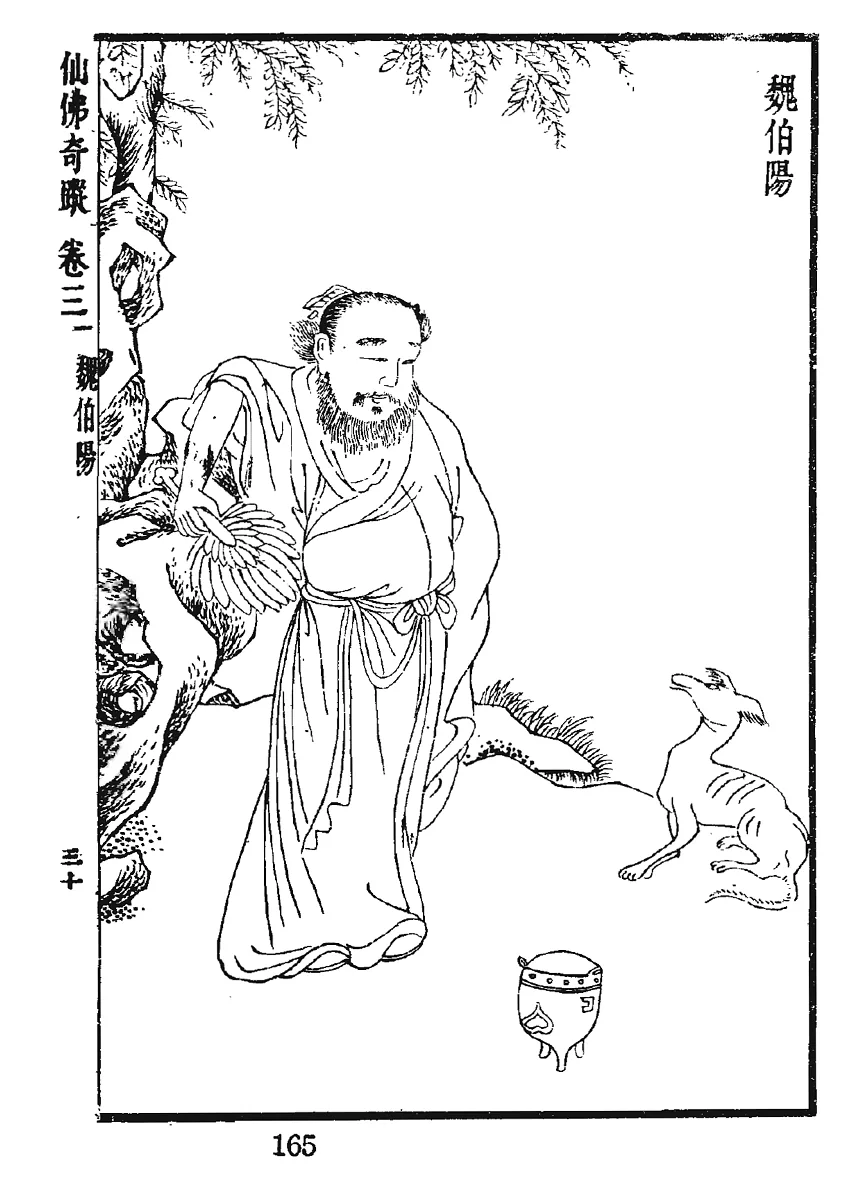
Tradition is clear. The author is Wei Boyang, an alchemist from Shangyu in the south, writing around the middle of the second century CE; he passed the book to a disciple named Xu Congshi, who passed it to Chunyu Shutong in the reign of Emperor Huan of the Later Han. Peng Xiao, whose commentary of 947 shaped every later reading, tells the story this way. That is the view most Chinese practitioners still hold.
Modern scholarship is less sure there was a Wei Boyang to write it. The biographies are late and openly legendary — in one, Wei and his disciples test their elixir on a dog, die, and are revived. Before the eighth century the text was more often credited to Xu and Chunyu than to Wei at all. And the book itself shows layers. Its cosmology is Han, but two passages closely track the Book of Changes commentary of Yu Fan, who died in 233; nothing in the surviving Han or early medieval laboratory literature shows its influence; and the first secure mention of it is in a poem by Jiang Yan, who lived from 444 to 505. Pregadio's conclusion is that the text "was composed in different stages, perhaps from the Han period onward, and did not reach a form substantially similar to the present one before ca. 450, and possibly one or even two centuries later."
Both positions are held by serious people, and this page does not need to choose between them. What matters is what neither side disputes: the book is old, it is composite, and by the time internal alchemy was being written down it already had the authority of a classic.
What is in it
Very little that looks like a recipe. The Cantong qi is a cosmology first. Its central figures are four trigrams from the Book of Changes. Qian ☰, three unbroken lines, is pure yang; Kun ☷, three broken lines, is pure yin. When they exchange their middle lines they become Li ☲, fire and the sun, and Kan ☵, water and the moon — and in the world we actually live in, Kan and Li are what Qian and Kun look like. Each carries a line of the other inside it: yang within yin, yin within yang.
That exchange is the whole program. If the original state was the pure pair, and the present state is the mixed pair, then the work is to take the true yang line out of Kan and return it to Li, restoring Qian. A practitioner of kan-li is doing this, by name, two thousand years later.
Around those four the text builds time. It maps the rise and fall of yin and yang onto the day, the month and the year: twelve "sovereign" hexagrams for the twelve months, each adding or removing one yang line; the sixty remaining hexagrams spread across the thirty days of a month, two to a day; the trigrams matched to the phases of the moon. All of these cycles became models for the fire phases — when to raise the heat, when to lower it, when to stop — and the idea that a transformation has a calendar, and fails if the calendar is ignored, is the most practical thing alchemy inherited from this book.
| Trigram | Lines | Stands for | In the work |
|---|---|---|---|
| Qian 乾 ☰ | three yang | heaven, pure yang | the original state to be restored |
| Kun 坤 ☷ | three yin | earth, pure yin | the vessel; receptive ground |
| Li 離 ☲ | yin inside yang | fire, sun, the heart | holds the "true yin" to be drawn down |
| Kan 坎 ☵ | yang inside yin | water, moon, the kidneys | holds the "true yang" to be drawn up |
Two traditions, one book
The oldest surviving commentary, from around 700, reads the Cantong qi as a manual for external alchemy: lead and mercury in a crucible. It is the only one that does. From the eighth century the internal alchemists took the text over, Peng Xiao's reading became the standard one, and every later commentary — with the single exception of the Neo-Confucian Zhu Xi, who wrote a textual study of it in 1197 under a Taoist pen name — reads it as describing a process inside the body.
Pregadio's view is that this is not a misreading in either direction. The alchemical passages use laboratory language, but the doctrine they express applies equally to a furnace or to a person, and the book seems to have been written to be that ambiguous. That is the hinge on which the whole history of Chinese alchemy turns: when the furnace moved inside the body, it did not need a new scripture, because the old one already permitted it.