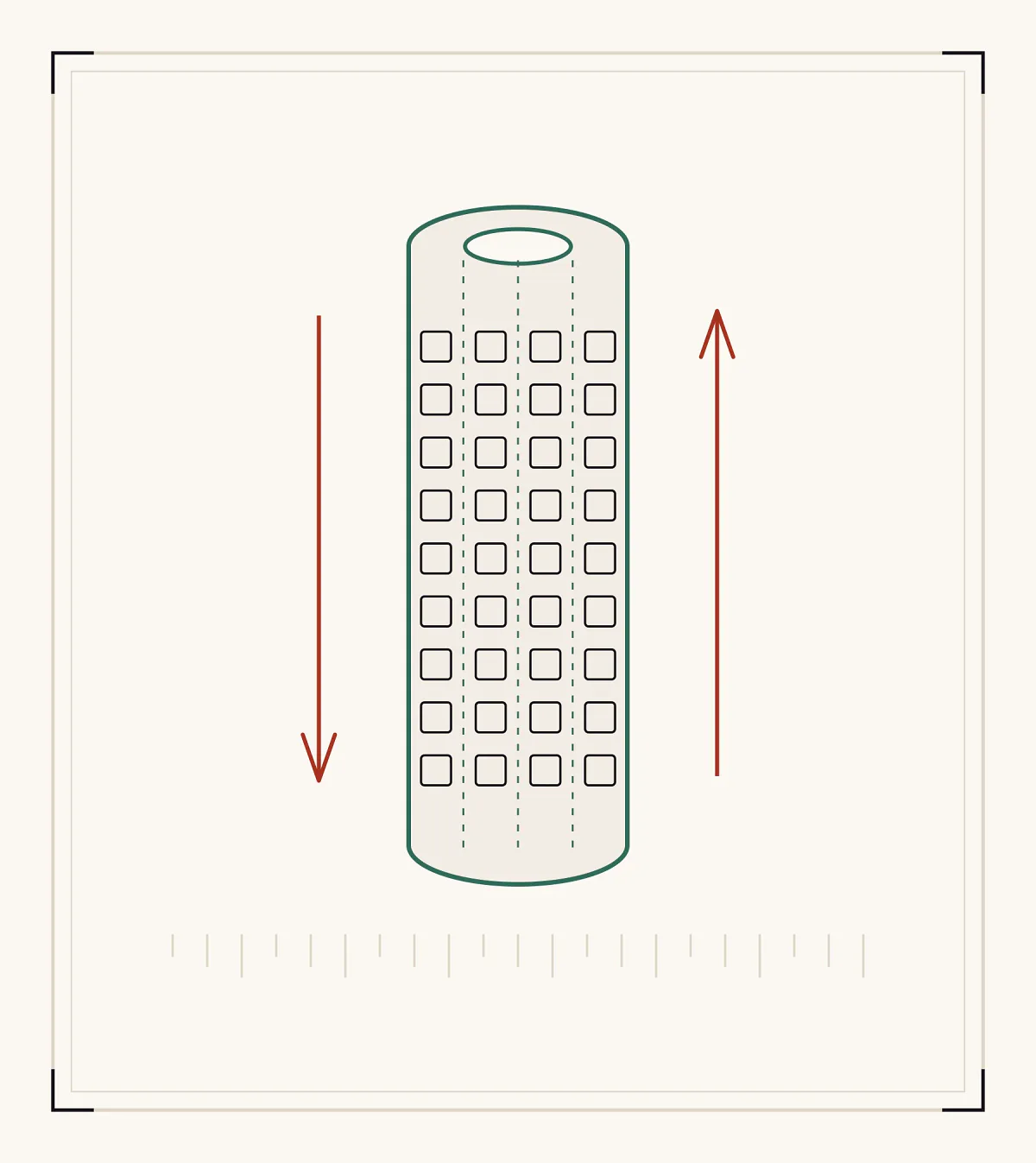
The Xingqi (行氣) inscription — "circulating the qi" — is a small block of jade, twelve-sided, bored through its length, carrying forty-five characters cut in columns around its faces. It is usually dated to the fourth century BCE, it is held in the Tianjin Museum, and it is the earliest surviving physical object that describes what this archive is about.
What it says
The text is a chain of short clauses, each picking up the last word of the one before, describing a cycle: the breath is taken deep, it gathers, it extends, it descends, it settles, it becomes firm, it sprouts, it grows, it returns upward, and it reaches the top. Then two lines locate the movement in a cosmology — the mechanism of heaven above, the mechanism of earth below — and a last line delivers the stakes: follow this and you live, go against it and you die.
It is not an instruction sheet. There is no posture, no duration, no count, nothing about where to sit and nothing about how long it takes. What it is, unmistakably, is a description of taking the breath downward into the lower body, holding it until something settles there, and then bringing it back up along a different route — the operation that a thousand years later becomes the small circulation and, at level 2, Mo Pai's own second stage.
Why an object matters more than a text
A text can be re-dated, interpolated, or turn out to be a later forgery attached to an old name; the history of Chinese philosophy is full of all three. An inscribed object recovered as an object is harder to argue with. The jade dates the idea of deliberate breath circulation to the Warring States independently of any manuscript tradition, and it does so in a form somebody paid a craftsman to cut into stone, which tells you the idea was worth preserving to whoever commissioned it.
The inscription entered modern scholarship largely through Guo Moruo, who published an influential reading of it in the twentieth century, and it has been discussed continuously since. The broad reading — a description of circulating breath — is not seriously disputed. The details are: how the character sequence divides, what several of the terms meant at the time, and whether the last lines describe a physiological route or a cosmological one, are all live questions, and translations differ in ways that matter to anyone trying to reconstruct a technique from it.
What it does not establish
That the practice is old is not the same as the claim that any particular modern system descends from it. Forty-five characters cannot carry a curriculum. They cannot tell you whether the circulation was daily or occasional, whether it was taught with a teacher, what it was for, or whether the people who cut it would recognise anything a modern practitioner does. The gap between this object and the elaborate mapped anatomy of internal alchemy is more than a millennium, and it is filled by texts, not by evidence of continuous transmission.