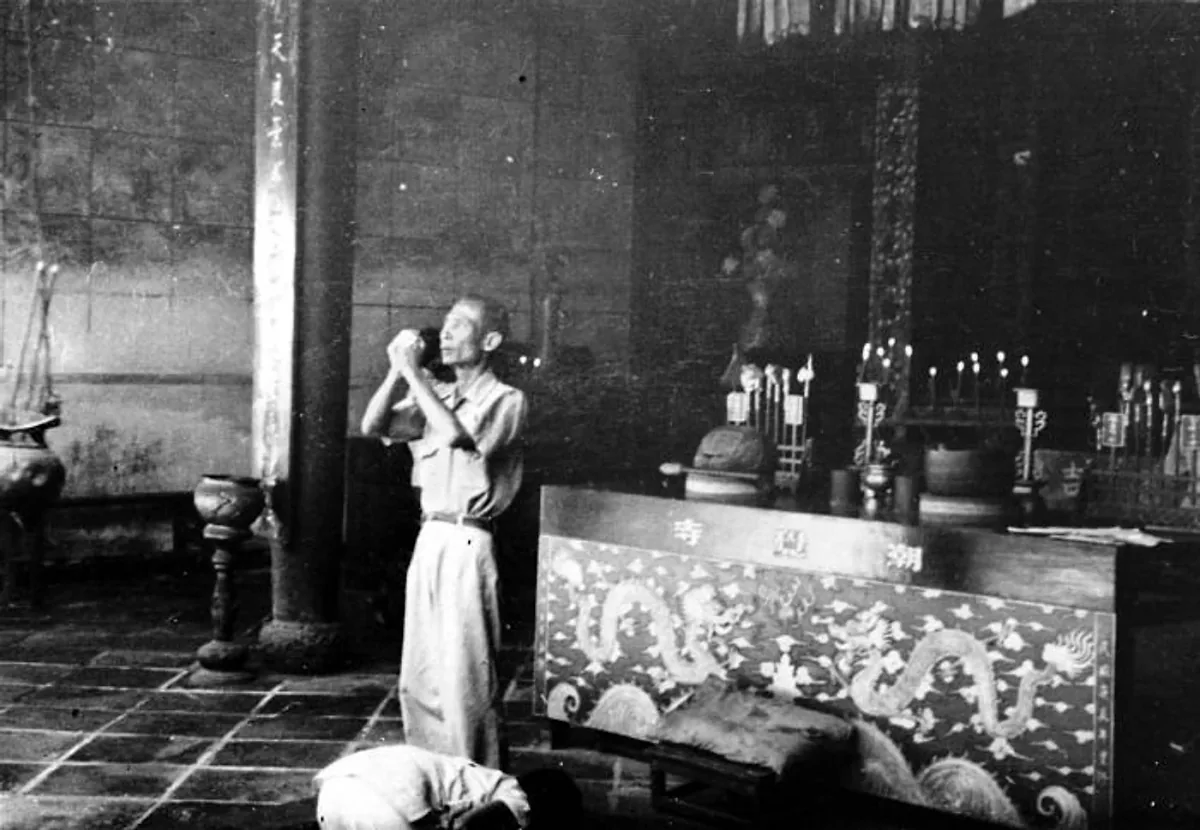
Mo Pai's modern history happens in Indonesia, and it happens there because of a diaspora that is older than the Dutch presence and considerably older than the Indonesian state. Any account of how a Chinese esoteric lineage came to be practised in Java has to start with the ordinary fact of Chinese people having lived there for centuries.
Settlement
Chinese traders were established in the ports of the archipelago before the fifteenth century, and Zheng He's expeditions in the early 1400s left communities and legends along the north coast of Java — the great temple at Semarang is dedicated to him. Under the Dutch East India Company, Chinese settlers became indispensable and precarious in the same breath: tax farmers, sugar millers, shopkeepers, intermediaries, and periodically the target of massacre, most notoriously in Batavia in 1740. Migration accelerated through the nineteenth century, and by the twentieth there were two broadly distinguishable populations — the long-settled peranakan, Malay-speaking and locally intermarried, and the more recent totok, still Chinese-speaking and still oriented toward China.
Community life ran through institutions the colonial state did not administer: clan and surname associations, native-place associations, business partnerships, mutual-aid societies, schools, and temples. Religious practice was correspondingly plural — a temple might house Taoist deities, Buddhist figures and Confucian tablets under one roof, and its congregation would not have found the combination strange.
Why a lineage would travel this way, and stay quiet
Martial and healing traditions moved along exactly these networks. A teacher arrived with a skill; the skill was taught inside a family, a surname association or a small circle of trusted students; and it stayed there. Nothing about that is unusual or sinister — it is how most Chinese martial and medical transmission worked everywhere, including in China — but it produces a documentary record close to zero. There is no register of who taught what to whom, because there was never any reason to keep one.
This is the context in which Mo Pai's account of itself is unremarkable rather than extraordinary. A Chinese immigrant in Java carrying an inherited practice, teaching one or two students, and forbidding transmission outside the Chinese community, is a completely ordinary description of how such things worked. It is also, and for the same reasons, a description that cannot be checked.